Guide
Remedial massage vs deep tissue massage: what's the difference?
The short answer
Remedial massage is an assessment-led treatment aimed at a specific problem. Deep tissue massage is a technique: slow, firm work into the deeper layers of muscle. In my studio, deep tissue is one of the tools I use within a remedial treatment when your body needs it, rather than a separate menu item. And firm doesn't have to mean painful.
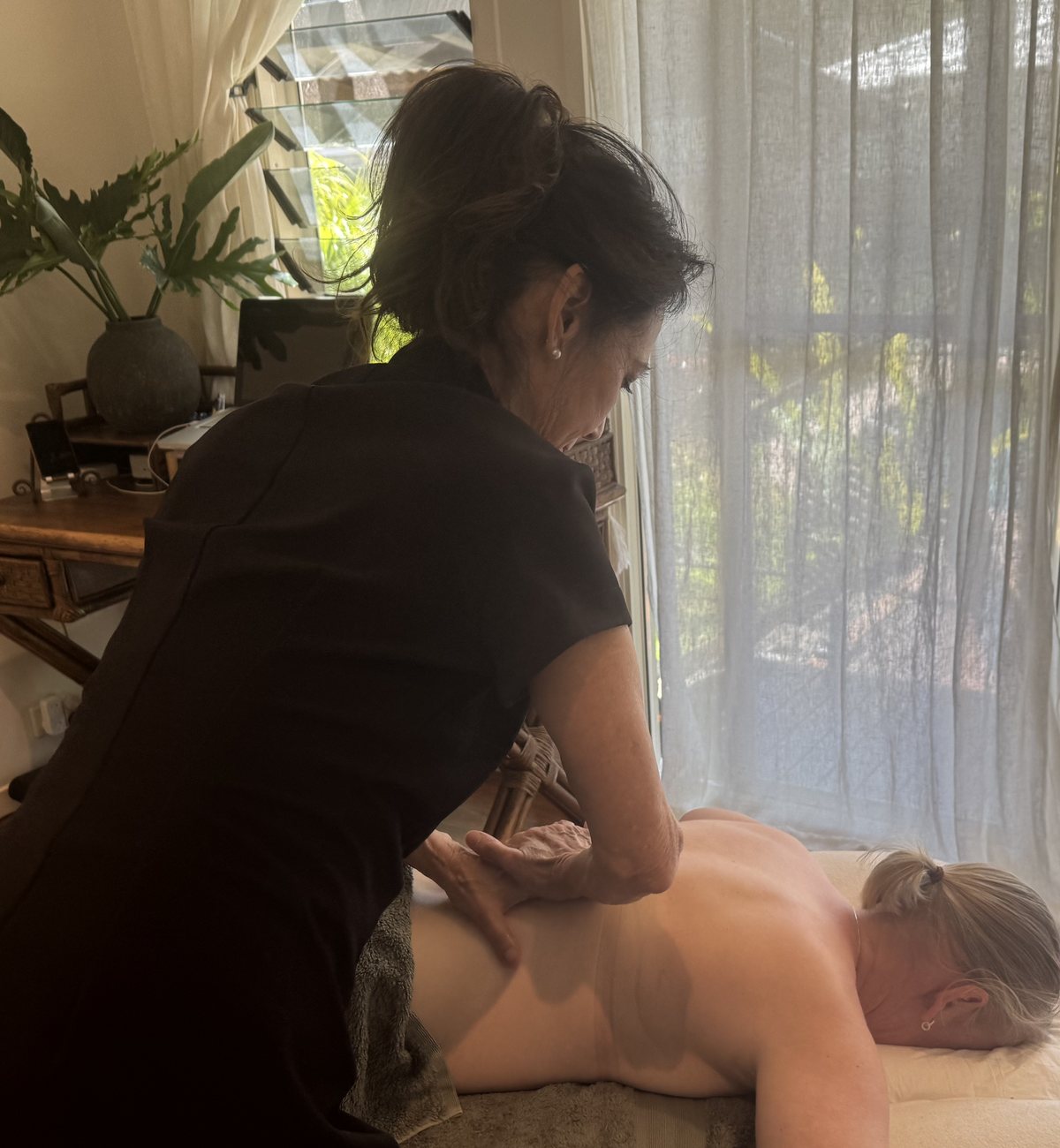
By Lauren Schoenauer Remedial massage therapist · Accredited Member & Fellow, Australian Traditional Medicine Society · Diploma of Remedial Massage · 20+ years in clinical practice Updated 15 November 2026 · Tewantin, Noosa
What is remedial massage?
Remedial massage is targeted, clinical treatment of muscle and connective tissue to ease pain, restore movement and correct dysfunction. The key word is assessment. Before I treat, I look at how you move, where the restriction is and how your body is compensating. The treatment plan comes from what I find, not from a routine.
Within one remedial appointment I might use several techniques, depending on what's going on:
- Deep tissue work for chronic tension in the deeper muscle layers
- Trigger point therapy for hyper-irritable spots that refer pain elsewhere, such as headaches that start in the neck
- PNF stretching, assisted stretch-and-resist techniques, to build flexibility
- Sports massage techniques for preparation, recovery and maintenance through training
What is deep tissue massage?
Deep tissue massage is slow, deliberate work into the deeper muscle layers. It's useful for long-standing tension that lighter styles can't shift: the shoulders that have been up around your ears for months, the lower back that tightens after every weekend in the garden.
Some places offer deep tissue as a separate treatment, which can be confusing. You might book it expecting the problem to be found and fixed, and get a firm, general massage instead. That's why I treat deep tissue as a technique within remedial work. If your body needs deep work, you'll get it. If a particular area needs a lighter touch, you'll get that instead.
Does deep tissue massage have to hurt?
No. Firm doesn't have to mean painful. There's a difference between the "good" pressure of a tight muscle letting go and pain that makes you tense up. Once you start bracing against the pressure, the muscle tightens to protect itself and the treatment becomes less effective.
I work with your breath and your feedback. I'll check in with you, and I want you to tell me if anything is too much. That's useful information for me, not a complaint.
A bit of tenderness for a day or two afterwards is normal, especially after a first treatment or when we've worked fairly deep. If it's still sore after a couple of days, or anything feels off, let me know and we'll adjust the approach next time.
Is remedial massage the same as relaxation massage?
No. Relaxation massage is a general, feel-good treatment. Remedial massage starts with assessment: I find the tissues causing the problem and treat them with specific techniques. You leave with a plan, not just an hour of calm, although most people find they relax anyway.
The difference matters for health funds too. Funds generally cover remedial massage from an accredited provider, and may not cover relaxation massage. See my guide to health fund rebates for what to ask your fund.
Which one should I book?
With me, you don't need to choose a style. Book a remedial appointment for the length of time that suits the problem, tell me what's going on, and I'll use whichever techniques your body needs:
- 30 minutes ($85): targeted treatment of one problem area
- 45 minutes ($105): one to two areas with assessment
- 60 minutes ($125): full treatment, and the most popular choice
- 90 minutes ($175): complex problems or multiple areas, full body
If you love firm pressure, tell me. If you're nervous about it, tell me that too. Either is fine.
Is deep tissue massage safe for everyone?
Deep work isn't right for every body or every day. I'll adjust or avoid deep pressure if you're pregnant (where I use proper positioning and a gentler approach where needed), if you bruise easily or take blood-thinning medication, if an area is recently injured or inflamed, or if you have a condition your doctor has asked you to be careful with. Please mention anything like this when you book or at the start of your appointment.
Why does it matter who does the work?
Deep tissue technique in inexperienced hands is where people get hurt or put off massage altogether. I've been in clinical practice for more than twenty years, first building one of Balmain's busiest remedial practices in Sydney and now from my private studio in Tewantin. Because I'm a sole practitioner, you see me every visit, so I learn how your body responds and how much pressure is right for you.
Book with Lauren in Tewantin
Every treatment starts with assessment, and you see me every visit. Private studio at 12 Cambridge Court, Tewantin, with off-street parking at the door. No referral needed.
30 min $85 · 45 min $105 · 60 min $125 · 90 min $175 · health fund rebates may be available depending on your fund and extras cover
View available appointments